Observing
Faint Outer Moons
With
the world’s best observing software
You
won't be able to see Jupiter's satellight Himalia in
moonlight, from a light-polluted location, or if is is too near to
the glare of the planet. Only SkyTools finder charts use a scientific
model to determine what you can see in the eyepiece, given the
conditions at the time of your observation, and as seen in your
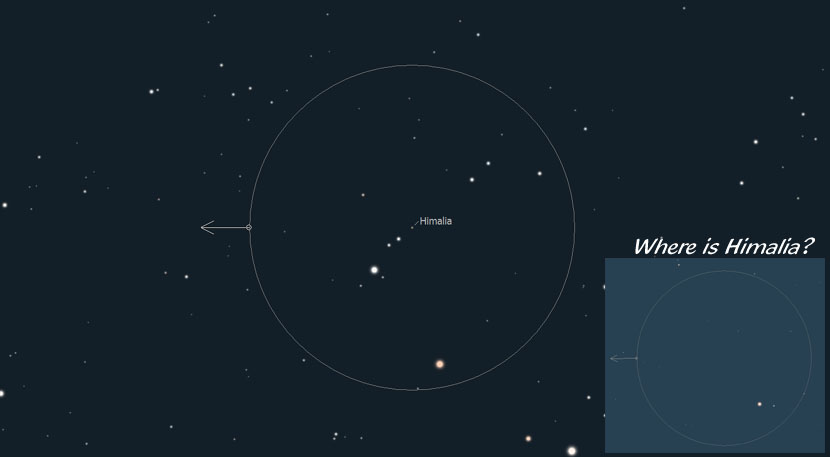
own telescope. Himalia is plotted above as it would appear in
an 18-inch Dob on the night of of January 22. The inset shows the
same view, also with the position of Himalia centered, but on the
night of January 7. The sky is too bright on this night for
Himalia to be seen, so it is not drawn on the chart. Note that there are fewer stars too.
Jupiter's
Himalia and Saturn's Phoebe are bright enough to be observed in
larger telescopes, but these satellites are seldom attempted
because they are so challenging to find using traditional methods
and software. The unique features of SkyTools can give you the
edge you need to bag these elusive objects.
Success
Requires Deep Charts
The
SkyTools Pro Edition star database goes down to 20th magnitude,
using the most reliable data available. The finder charts will
display only those stars that will be visible in your eyepiece and
it will match the orientation, making it a snap to identify both
the field and your moon. There is no need to place field of
view circles; SkyTools draws them automatically based on your
telescope info.
Success
Requires Planning
Spotting
these moons is difficult even with a
large-aperture telescope. At a minimum, success requires the
satellite to be well above the horizon, far away from the glare of the
planet, and without the interference of twilight or
moonlight. The SkyTools planner uses our scientific model to
tell you when your best chances are to spot the satellite, and which of
your eyepieces to use.
Is
my telescope large enough?
Is
my sky dark enough?
Is
the moon away from the glare of the planet?
SkyTools
can answers these questions. There is no need to waste your time
looking on the wrong night or from your light polluted backyard if
you can't reasonably expect to see it.

SkyTools
3, because it's the astronomy that matters.
Read
more about SkyTools 3
|