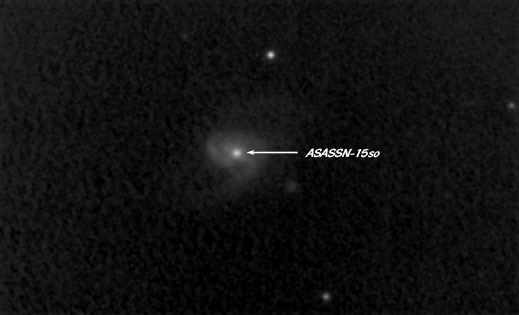
I
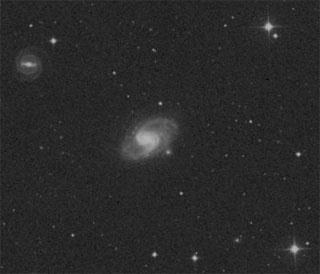
took this image of NGC 3583 and the supernova with iTelescope
T11 on the night of January 21. The moon was full at the time,
so it is of fairly low quality. But it does clearly show the
supernova near the center of the galaxy. This is a stack of three,
5-minute exposures in the Luminance filter. I used SkyTools 3 to
plan the observation. It helped me decide that it was worthwhile
to expose with a full moon.
A long time ago in a galaxy far away a star
exploded. The galaxy is NGC 3583, which appears to us as a 12th
magnitude barred-spiral in Ursa Major. But
the story begins even longer ago, when two stars were born out of
a cloud of interstellar gas and dust. They orbited around one
another in a cosmic dance, forever connected by gravity. One of
these stars was much more massive than the other and for a long
time it dominated. But massive stars are like bright candles
burning at both ends. They may have more fuel to stoke the nuclear
fires within, but they go through it much faster. Eventually
the massive star began to run out of fuel. It first expanded,
tossing it's outer layers into space, and then it eventually
collapsed. When it collapsed, it became a tiny white dwarf star. A
white dwarf is small, compact, and very hot. It no longer burns to
shine brightly. A white dwarf is like a hot cinder left behind
after the fire. It will very slowly cool and dim, provided nothing
else happens to it. A normal star
keeps from collapsing by burning (or fusing) elements, generating
energy which pushes out against its own gravity. No longer
burning, a white dwarf collapses down to the point where only the
force between electrons continues to hold it up. As
always, the white dwarf's dance partner was still there. The
partner star eventually began to run out of fuel itself, and
expanded. When it did, it began to dump its outer atmosphere on to
its little partner. The white dwarf began to grow more massive
until one day it approached the Chandrasekhar limit--the point
where electrons can no longer keep it from collapsing. Or perhaps,
the other star too became a white dwarf and the two spiraled into
each other, merging into one much more massive white dwarf. Regardless,
the white dwarf began to burn again, initiating a runaway process
where carbon and oxygen are fused into heavier elements,
generating an enormous amount of energy all at once. Much of the
star was blown apart, and for a brief period of time this one star
outshined the combined light of billions of its brethren in the
galaxy. This was a type Ia supernova. Eventually
the remains of the star will collapse further until only the
pressure between neutrons can keep it up, forming a brand new
neutron star. The shock wave from the
explosion spilled heavy elements into the surrounding space,
seeding clouds that may one day form stars and planets. This
shockwave may even have caused clouds to collapse, directly triggering
the formation of new stars. The light from the explosion shined past
the edge of the star system. It shined past nearby stars in its
galaxy, passing far away planets that we will never know. It
shined out into its galaxy and beyond into intergalactic space. For
over a hundred million years the light traveled across the void,
eventually entering our own galaxy, and solar system, with some
small part finding its way through the atmosphere of the earth and
into a telescope. If you should dare to be so bold as to go look
for it, you may capture a tiny bit of this light with your very
own eye. This supernova was
discovered by the All
Sky Automated Survey for Supernovae at The Ohio State
University, using data from the quadruple 14-cm telescope in
Hawaii, called "Brutus." It was first detected on
November 8 at magnitude 15.1. The most recent observation is from
December 14, when it was magnitude 13.9. I had not intended to do photometry
with my images, but I estimate the supernova has faded to
magnitude 14.9, a whole magnitude fainter. I updated the magnitude
used in planning the visual observations below to 14.9. Planning
Your Observation
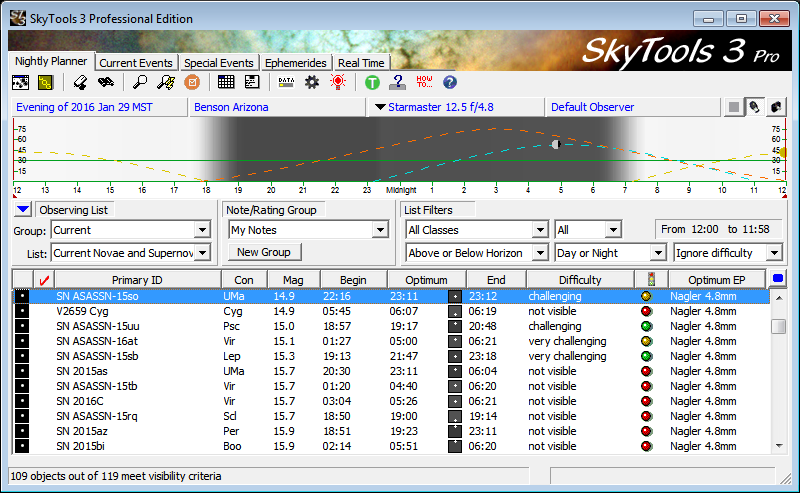
Note
that we have made the window as small as possible to fit the space
here.
The
SkyTools 3 Nightly Planner is set up (above) for January 29 at
Benson Arizona for a 12.5-inch (32 cm) Starmaster telescope. The Current
Novae and Supernovae observing list is loaded. This list is always
kept up to date with the
latest supernova data.
SN
ASASSN-15so is selected. The graphic at the top shows the darkness of the
sky during the night. The red dashed line is the altitude of the supernova,
which won't be high in the sky until 3 AM. The teal line is the altitude of the moon, which you can see
rises at around 23:11 (11:11 PM). After that the sky will be
significantly brighter as seen by the shading, which takes into
account the actual brightness of the moon on this particular night.
We
want to observe the supernova when it is at its highest in a dark sky, but on this night we must compromise. Is it better to wait
until the supernova is high in the sky, or should we have a look
before the moon rises? SkyTools calculates how difficult it is to
see the supernova throughout the night and it has determined that,
in this case, a dark sky trumps altitude. Our best chance to spot the supernova will be just before the moon
rises. Even then it will be challenging to spot.
When
I looked at the following nights, I found that by February 1st we
can observe the supernova in complete darkness when it is high in
the sky, but it will still be "difficult" to
detect in this telescope from this location. The visibility of the
galaxy depends to a greater extent on a dark sky, but should still
be visible in a 12.5-inch (32 cm) telescope from locations with a naked-eye
magnitude limit fainter than 5.5.
Click
on the image below to see a full size printable finder chart (pdf)
that was made by
right-clicking on the supernova in the planner.
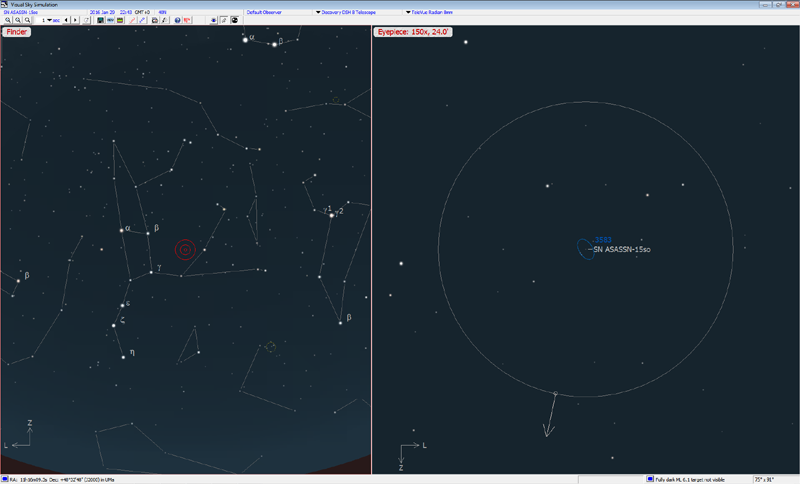
The
left side shows the naked-eye sky with Rigel QuikFinder
circles at the location of the supernova.On the right is the view in
a wide field eyepiece. The orientation and magnitude limits are calculated for the time and location, including light
pollution, twilight, and moonlight.
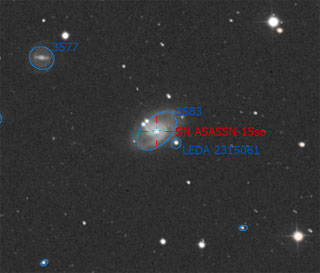
This
screen capture from the Interactive Atlas shows the
position of the supernova superimposed on the galaxy. The
supernova is dead center, and could easily be mistaken for
a bright core of the galaxy. |
This
image from the second generation Digital Sky Survey was
taken long before the supernova. Note that the galaxy has
no bright, star-like core. |
Once you have found the field, look for a
small elongated fuzzy patch of sky. This will be the galaxy.
Insert a higher-magnification eyepiece in order to make the supernova
more visible. Look for a star at the center of the galaxy. This
will be the supernova.
Greg Crinklaw — Developer of
SkyTools
SkyTools
3, because the astronomy matters.
Read
more about SkyTools 3
|