Uranus as seen at 9
PM mid-month from 40N, looking south. The star of similar
brightness to the right of Uranus is Zeta Psc.
In
November 2016 the planet Uranus is well placed for evening
observation, fairly high in the sky at around 9 PM. It is in
Pisces, shining at magnitude 5.7, just to the east of the
5th-magnitude faint naked-eye star Zeta Psc.
Uranus was not known
in ancient times, presumably because it is not detectable to the
naked eye throughout the year. But from a dark site at the right
time it is just detectable to the eye, and right now is
perfect.
Not many people can say that they
have spotted Uranus with their unaided eye, and this may be your
best chance. Start by going outside on a dark moonless night
before 9 PM. Make sure there are no lights nearby. Enjoy the sky
for about a half hour to let your eyes fully adapt to the dark.
Don't use a phone, flashlight (unless it has a red light), or run
inside for a snack. Bring a pair of binoculars if you have
them.
Start by identifying the bright
stars in the chart above. The bright star near the center is Beta
Cet. Alpha Cet is the bright star to the upper left. Once you have
spotted these two stars you should be able to navigate to Uranus.
If you can't spot the pair of "stars" that are Uranus
and Zeta Psc, try your binoculars. The trick with binoculars is to
fix your eyes on the area of the sky where you want to look, then
while holding your gaze fixed, bring the binoculars up to your
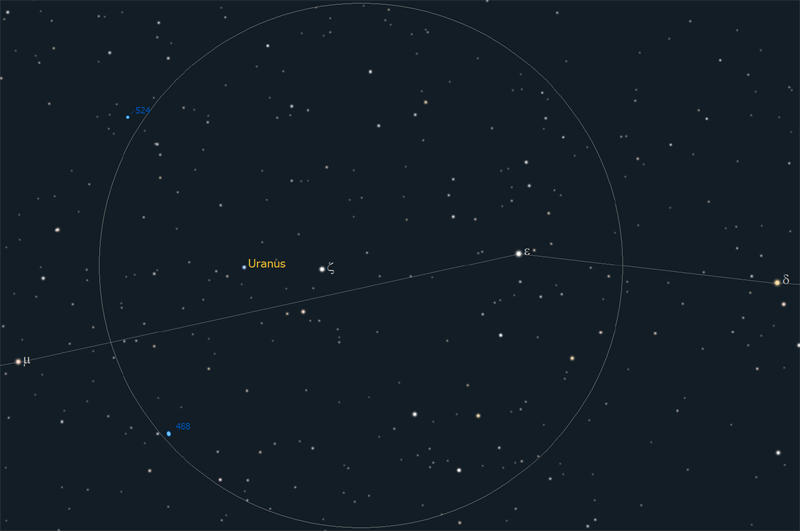
eyes. Look for a pair of "stars" as shown below. Uranus
should stand out because of its odd blue-green color. In the chart
below the bright stars are labeled with their lower-case Greek
letters, starting with Mu on the left, Zeta (to the right of
Uranus), Epsilon, and finally Delta on the far right.
Once you have spotted Uranus in
your binoculars, try keeping your eyes fixed on the spot and
lowering the binoculars. Look again with you unaided eye for the
side-by-side pair of stars.
Uranus was officially discovered by William
Herschel in England on the night of March 13, 1781. Herschel
was
a musician by trade, but he spent
his nights surveying the sky. He wrote, "In examining the
small stars in the neighborhood of H Geminorum I perceived one
that appeared visibly larger than the rest..." Herschel's
discovery was by no means an accident. He built the largest
telescopes of the day--the first practical application of the
reflecting telescope invented by Newton. Assisted by his sister
Caroline, Herschel set out to observe every star in the sky. As he
put it, "In a regular manner I examined every star in the
heavens and that night it was its turn to be discovered."
In the telescope,
use
as much magnification as the conditions will bear to see Uranus's featureless
tiny blue-green disk. At higher magnifications any
telescope will reveal more than a mere star.
Observing
the Moons of Uranus
Uranus
has 27 moons discovered to date, five of which can be
observed from earth. Of those five, the four largest are
visible in amateur instruments. The two outer moons,
Titania and Oberon, are each about 1600 km in diameter,
about half that of Earth's Moon. The two inner satellites
are smaller, about 1200 km in diameter. The moons of
Uranus are unique in that their names pay homage to the
works of Shakespeare and Alexander Pope.
Unlike
the other planets, Uranus is very highly tilted with
respect to its orbit; it lies nearly on its side, tilted
by some 98o.
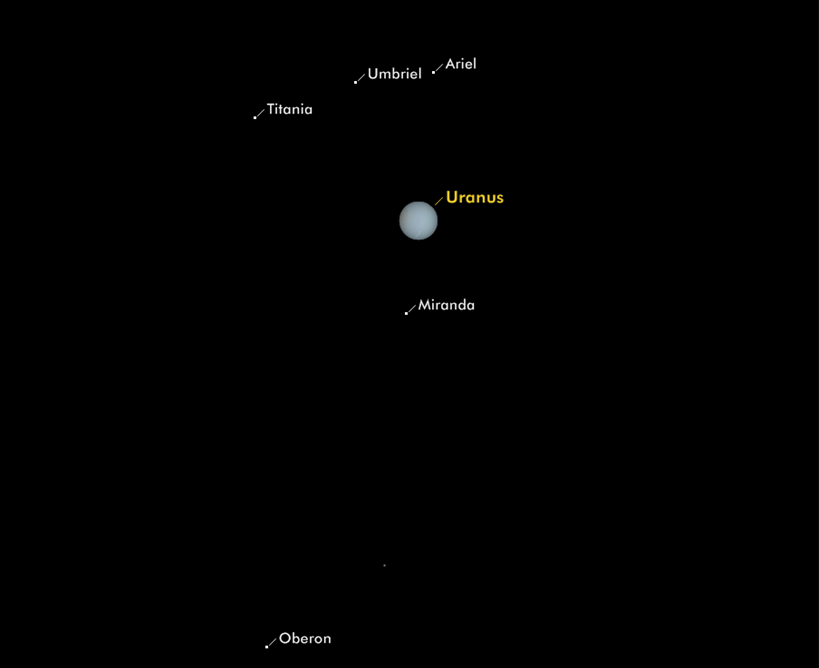
 The
moons will appear as faint stars near the planet. Their
orbits are tilted such that they trace a wide, egg-shaped
path. They are best observed when farthest from the
planet, which occurs when they are to the north or south
of it, although they can often be observed at other times
as well. The
moons will appear as faint stars near the planet. Their
orbits are tilted such that they trace a wide, egg-shaped
path. They are best observed when farthest from the
planet, which occurs when they are to the north or south
of it, although they can often be observed at other times
as well.
To
spot the tiny satellites, use high magnification, and wait
for moments of good seeing. Try averted vision--experiment
with looking away from the planet and trying to spot them
with your peripheral vision, which is more sensitive to
faint objects.
Darker
skies and an eight-inch (20 cm) telescope will be required
to spot the two outer moons, Titania and Oberon. A 16-inch
(41 cm) telescope is required to spot the two inner moons,
Ariel and Umbriel.
| Satellite |
Separation
(arc-sec) |
Magnitude |
| Titania |
17 - 31 |
13.9 |
| Oberon |
23 - 42 |
14.1 |
| Ariel |
7 - 14 |
14.4 |
| Umbriel |
10 - 19 |
15.0 |
| Miranda |
4 - 9 |
16.5 |
For best
results, use software to plot the positions of the moons
before you go out to observe them. Remember, they are
easiest when away from the glare of the planet. More
advanced software, such as my SkyTools 3, will compute the
times when the satellites are farthest from the planet for
you.
Uranus
will close on nearby Zeta Psc until late December, when it
will be 35 arc-minutes away. After that it will begin
moving back in the direction that it came from.
|
SkyTools 3 was used in the preparation of
this article.
Greg Crinklaw — Developer of
SkyTools
SkyTools
3, because the astronomy matters.
Read
more about SkyTools 3
Download
and try the Starter Edition
|