Observing
NGC 128
With
the world’s best observing software
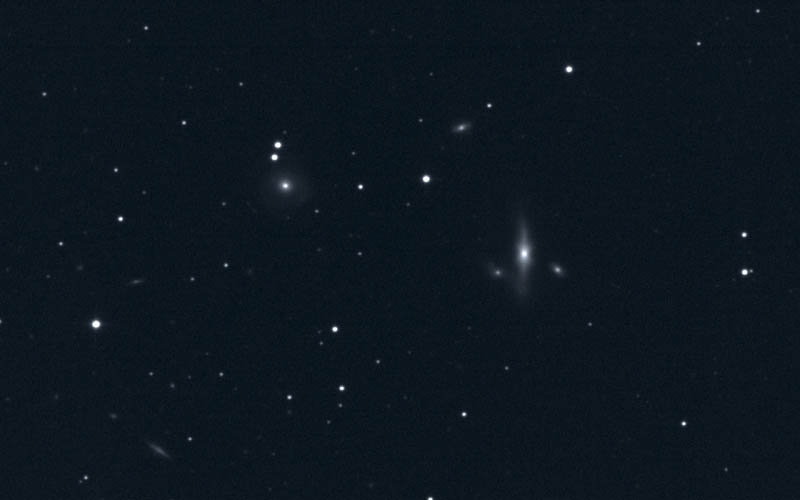
I
took this image of the NGC 128 field on September 10th with a remote
17-inch astrograph located in Australia (T32), on the iTelescope.net network. It
is a stack of five 3-minute exposures in the Luminosity filter
plus three 3-minute exposures in the Red and Blue (5X180L +
3X180RB). I used SkyTools 3 to plan the imaging session. NGC 128
is the larger galaxy on the right with the "X" shape at
the center.
NGC 128 is a tiny edge-on spiral
galaxy with an unusual twist. It has been distorted by tidal
interaction with its neighboring galaxies, resulting in an
"X" shape near the center. Walter Scott Houston wrote
that he was able to view this galaxy in his 5-inch from a dark
site. An 8 to 10 inch instrument will show the peculiar shape at
the center, which may appear to be box-like in the eyepiece. Be
sure to use at least 200x, and observe when very high in the sky
on a night of good seeing (steady air).
Computer modeling has shown that
the peculiar "X" shape can be attributed to the merger
or accretion of a small galaxy. In other words, NGC 128 ate one of
it's neighbors. The shape is made of tidally distorted disk
material from the larger galaxy.
There are quite a few tiny
galaxies visible in this field in my 18-inch. NGC 128 is the
brightest, with the nearby NGC 125 coming in a close second. Due
to the small size of NGC 128, I used 430x for the best view. It
appeared as an irregular shaped, elongated smudge with two
attendant smudges to either side (NGC 127 & NGC 130). The main
portion appeared to be box like, wider at the north end. It had
that irregular, speckled look that comes when there is detail
beyond your ability to resolve. On seeing this, it was easy for me
to understand how the great observers of previous centuries
imagined all nebulae to be made up of unresolved stars, something
that happens to be true in the case of galaxies such as this one,
although here the "speckling" is more attributable to
larger scale structure in the galaxy.
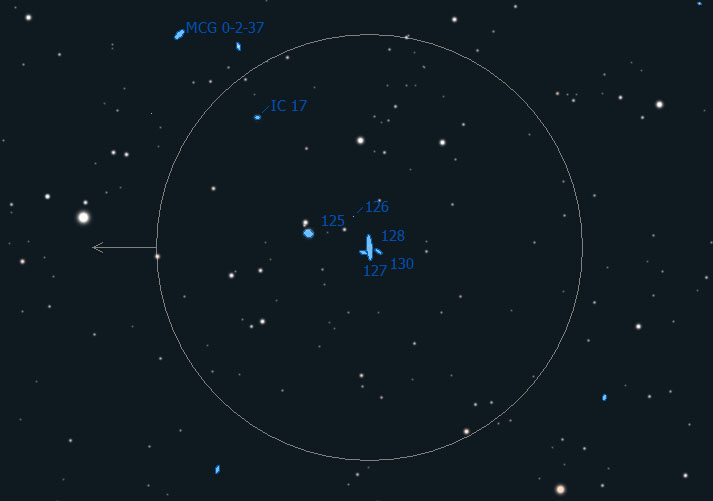
The field depicted by
SkyTools 3 in a 10-inch f/4.5 at 75x. North is down and east is to
the right.
The galaxies that flank NGC 128
(NGC 127 and NGC 130) are likely nearby in space as they all have similar
redshifts, so they are at roughly the same distance. The same can
be said of the other galaxies nearby, such as NGC 125 and NGC 126.
Together, these galaxies form a cluster, loosely referred to as
the NGC 128 group.
Going
Beyond the Messier and Caldwell Catalogs
You
won't find NGC 128 in the Messier list, yet it is detectable in a
five-inch telescope
from a dark site. The main reason
most observers have never hunted it down is it's relative
obscurity.
Amateur
astronomy can sometimes get stuck in a rut. Beginning observers
start with the Messier or Caldwell objects, and some never go
beyond them. For those who do go deeper, a natural starting point
is the observations of the great visual observers of the 18th and
19th centuries, which were compiled in the NGC catalog. But even they
didn't spot every observable object in the sky. Just as the
beautiful galaxy NGC 253 is not observed as often as it deserves
to be simply because it does not appear in the Messier catalog,
there are bright or interesting objects that don't get much
attention because they aren't found in the NGC/IC.
One
of the purposes of SkyTools is to take serious observers to the
next level--beyond the confines of even the NGC/IC catalogs. Here are
some of the ways it can do this:
-
SkyTools
has large and highly corrected databases from a
combination of many sources, not limited to the NGC
catalog or any other single source.
-
The
ability of SkyTools to accurately determine if any type
of object is detectable in the eyepiece of your
telescope, under your observing conditions, allows
it to break the boundaries of catalogs like the Messier or NGC by simply
asking, "is this object detectable?" Other products
make gimmicky or generic predictions of visibility. SkyTools
takes all of the factors into account at the time of the
observation, including light
pollution, astronomical seeing, altitude in the sky, and the presence of moonlight. These
things matter.
-
There
are over a hundred pre-made observing lists available
for SkyTools that have been created by leading observers from
around the world. Once loaded into the planner, it is a simple
matter to filter down to those objects that you can expect to
see.
-
The
Nightly Observing List Generator is an awesome tool for
finding little-known objects. It can generate a custom
observing list of lesser-known objects that you can expect to
see with your telescope on any given night.
-
For
all but the brightest objects, it is critically important
to observe on the right night, and at the right time in
order to get the best view. This is when you have the best
chance of seeing more than a blur. The
SkyTools planner uses sophisticated models and algorithms to
give you the best view possible. Don't be fooled by
similar-sounding but much less sophisticated apps.
-
For
star hoppers, the unique three-view finder charts
customized for you make
it simple to locate any object, even if not obvious in the
eyepiece.
-
For
faint objects in large-aperture telescopes it is essential
that there are enough stars plotted on the screen/chart in
order to locate the correct field, even when using GOTO. The
Pro Edition of SkyTools has stars down to 20th magnitude
for this purpose.
Greg Crinklaw — Developer of
SkyTools
Example
SkyTools Finder Chart for an 8-inch Telescope with Telrad (pdf)
SkyTools
3, because it's the astronomy that matters.
Read
more about SkyTools 3
|