This
NGC
7008 image was created via color synthesis of Red & Blue Digital
Sky Survey images. North is down and east is to the right, as
typically seen in a telescope.
NGC
7008 is one of my all-time favorite objects in the eyepiece.
Offering something interesting to see in all but the smallest telescopes,
this planetary nebula is a must see. If you have not seen it for yourself, now
is a good time to have a look. It will be an evening object
through October.
 Called the Fetus nebula because of its
appearance in photographs, NGC 7008 is a planetary nebula located
in the constellation of Cygnus. Its integrated magnitude is
~12, making it detectable in all but the smallest telescopes. Called the Fetus nebula because of its
appearance in photographs, NGC 7008 is a planetary nebula located
in the constellation of Cygnus. Its integrated magnitude is
~12, making it detectable in all but the smallest telescopes.
NGC 7008 was discovered by by William Herschel in 1787 using
his 18.7-inch telescope. It was originally given the designation H I-192.
My first view of this planetary came way
back in 1998 in a six-inch (15 cm) Newtonian. I had a peek before
reading about it or even looking at any pictures.
I was very surprised at what I saw. Rather than the small, oval
disk that typifies these objects, it was more of a dash,
emanating to the north from the nearby pair of bright stars. At
50x it reminded me of a tiny comet with tail. The best view was at 135x, where it looked like a hazy dash of light. At
270x it looked like an edge-on spiral galaxy. I was so struck by
this that I went inside to verify that I was indeed looking at a
planetary nebula! I couldn't wait to have a look in
a larger instrument. Several years later
I completed my 18-inch (46 cm) Dob, and NGC 7008 was on my list of
objects to see right away. Much more detail was apparent, and even
at 94x the full circle of the nebula appeared, ring-like,
symmetrical about a bright central star. I noted that the north
end had a bright knot in it, as seen in photographs. The oval ring
stretched around to the west from there, meeting a similar, but
less prominent knot on the southwest end. The eastern part was
almost dark, which is what leads to the strange question-mark or
dash-like appearance in smaller instruments. The OIII filter
improved the contrast with the nebula in general and brightened
the appearance of the knots, but it didn't help much in discerning
the dimmer portions of the ring. I am told that in larger
instruments even more detail is apparent. The
colorful wide double star at the south end of the nebula is also
very pleasing. The primary is HD 235422, a cool red 9.5-magnitude
K7 star. It forms a double, known as HJ 1606, with a 10 to
11th-magnitude star some 18.5 arc seconds away. This star is
somewhat bluish in color, making a nice contrast with the primary.
Observing
the Fetus Nebula for Yourself
One
of the reasons that NGC 7008 isn't observed more often is that it
lies way out in the middle of nowhere. It's not an easy find like the
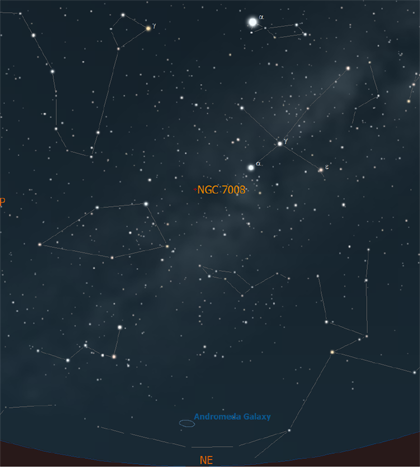
Ring Nebula. It lies on a rough line between Deneb (Alpha Cyg) in
Cygnus, and Alderamin (Alpha Cep) in Cepheus, and there are few
bright stars in the region. If you use traditional star hopping to
find your objects, it may be difficult and time consuming.
The
link below is for a SkyTools finder chart that may help. It
is a pdf that you can view on your mobile device or print
and take into the field. The view on the left shows what you
would see with your unaided eye near Tucson, AZ. The three
concentric circles are for a typical unmagnified finder such
as a Telrad. Start by pointing your own finder at the same
location in the naked eye sky in relation to the bright
stars. This will work even in a light polluted sky. The
idea is that even if you aren't exactly in the right spot
you will be pretty close. Insert your widest field eyepiece.
Look for a faint fuzzy spot. If you are lucky, it will be
apparent. |

The view in an 8-inch telescope
at 150x.
|
If
not, you will need to match the star patterns in the eyepiece to
find the objects. Note that the chart is for an 8-inch telescope
with little light pollution. Normally you would make a chart to
match your own telescope and conditions. If you use an alt/az scope in the
evening, the orientation should be about the same as what you see in
the eyepiece. Otherwise you may need to rotate the view to match.
Look for a pattern of bright stars that you see in your eyepiece.
It's ok to move the scope around a bit to see what is in the area.
Once you find a memorable pattern in the eyepiece, look for it on
the chart. Once you have identified where you are looking, it should
be apparent which direction you need to move the telescope to find
the nebula. Once
found, center it, and insert a higher power eyepiece.
Finder
Chart (pdf) The
Science of NGC 7008
Approximately 2,800 light years distant, the
nebula itself is about a light year in diameter. A planetary
nebula is the result of a sun-like star that has reached a sort of
old age. The Hydrogen that was fused into Helium to power the star
in a stable manner for billions of years becomes scarce in the interior.
As a result the outer atmosphere expands and cools, and the star
becomes a red giant. Eventually helium begins to fuse in the
core and the star swells a second time. This is called the Asymptotic
Giant Branch (ABG) phase, named for its position on the H-R
diagram. The star begins to pulse, expelling the loosely held
material in its outer envelope. This material expands away from
the star, creating the so-called planetary nebula.
NGC 7008 appears to be two different
shells of gas, one within the other. It has been suggested that
this might be the result of a binary pair of sun-like stars at the
center of the nebula, with first one passing into the AGB phase,
followed by the other. But it is also possible that we are seeing
the result of complex interactions of the ejected material with
the surrounding interstellar medium, possibly even influenced by
the presence of planets and other minor objects orbiting the star.
SkyTools 3 was used in the preparation of
this article.
Greg Crinklaw — Developer of
SkyTools
SkyTools
3, because the astronomy matters.
Read
more about SkyTools 3
Download
and try the Starter Edition
|