Focus On Observing Saturn
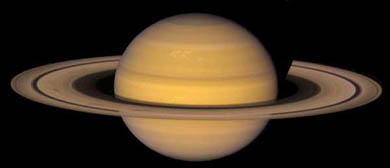
For any telescope; Updated February 2006
February finds the most spectacular of the planets well placed for evening observation. Look for it as the bright yellowish "star" rising high in the east at sunset. Saturn is in the constellation Cancer just west of the Beehive cluster.
Saturn offers more than just those spectacular rings: observers can try for a glimpse of atmospheric features, view gaps in the rings, and search out the tiny moons--all of which provide interesting challenges for scopes both large and small. Saturn is in a fairly dense field of stars this month, providing a pretty backdrop against which to watch the planet move. Many stars will pass near the planet making it more difficult to be certain you have seen a moon. There are also many opportunities to watch various moons pass close to background stars.
Saturn in February
Size Magnitude Con Distance From Earth Visible Moons 20' x 16' -0.4 Cnc 8.2 AU 8
The
Satellites of Saturn
 Saturn
offers eight satellites that are visible in amateur instruments.
Smaller telescopes will reveal the four brightest moons; seeing all eight
is a challenge for the largest telescopes.
Saturn
offers eight satellites that are visible in amateur instruments.
Smaller telescopes will reveal the four brightest moons; seeing all eight
is a challenge for the largest telescopes.
The following table lists the relevant data for the moons of Saturn in order of easiest to hardest to observe. Iapetus varies in brightness with the side of saturn it is on. It is brightest when west of the planet. The required scope column is only meant as a guide -- it may be possible to see some satellites in smaller scopes under good conditions. Hyperion is not only faint, but it is a technical challenge because it wanders so far from the planet that you need excellent charts to know which "star" it is. Mimas is difficult in any telescope because it is both faint and very close to the planet.
Satellite
Mag.
Max. Elongation
Orbital Period
Req. Scope
Titan
8.1
3'17"
15d 23h
Any Scope
Rhea
9.5
1'25"
4d 13h
2"
Dione
10.2
1'01"
2d 18h
2"
Iapetus
10.9-12.4
9'35"
79d 8h
3"-6"
Tethys
10.0
48"
1d 21h
6"
Enceladus
11.5
38"
1d 9h
6"
Hyperion
14.0
3'59"
21d 7h
8"
Mimas
12.7
30"
22h 37m
16"?
Finding
a moon near the limit of your telescope requires good seeing and knowing
where the moon is relative to the planet. Saturn should be high in
the sky when you observe it. Use high magnification for those moons
closest to Saturn. A well-baffled telescope greatly enhances
your chance of success for these by reducing the scattered light from the
planet.
Observing the Rings
Another major feature is the the main gap in saturn's rings, called the Cassini division. It can be spotted on nights of good seeing in even the smallest telescopes (3"). Look for it about 3/4 of the way out from the inner edge. The ring to the outside of this gap is called the "A" ring. The brighter ring that lies to the inside is called the "B" ring.
Another division, commonly referred to as Enke's gap, is much narrower and more difficult to see. Look for it near the outer edge of the "A" ring, about 7/10 of the way out.
Another
elusive target is the "C" or "Crepe" ring. This ring lies just inside
of the B ring. Look for it in silhouette, as a darkening of the planet
to the inside of the "B" ring. This ring can sometimes also be glimpsed
as a very slight brightening to the inside of the B ring away from the
planet's disk.
Atmospheric Detail on the Planet Itself
|
|

